

Cognac and whiskey both get poured into the same category — "brown spirits for after dinner" — but they don't share a single production rule. One is distilled from grapes. The other is distilled from grain. One can legally be made in exactly one place on Earth; the other can be made almost anywhere, under wildly different national standards. Once you see where the rules actually diverge, the taste differences make a lot more sense.
Is Cognac a Whiskey?
No. Cognac is brandy — a spirit distilled from fermented grape wine. Whiskey is a grain spirit, distilled from a fermented mash of barley, corn, rye, or wheat. They land in the same glass at the end of a meal, and both get aged in oak, but they start from a completely different raw material and fall under separate legal categories almost everywhere they're regulated.
The confusion is understandable. Both are amber-colored, both are typically bottled around 40% ABV, and both get described with the same tasting vocabulary — vanilla, oak, dried fruit, spice. But "cognac" and "whiskey" aren't two styles of the same spirit the way VSOP and XO are two styles of the same spirit. They're two entirely different spirit categories that happen to end up looking similar in the glass.
Grapes vs. Grain: The Base Ingredient
Cognac starts as wine. Producers ferment Ugni Blanc grapes (with small allowances for Folle Blanche and Colombard) into a thin, acidic base wine around 9% ABV — too sharp to drink on its own, but exactly what the still needs. There's no malting, no mashing, no grain involved at any stage.
Whiskey starts as a grain mash cooked into something closer to unhopped beer. The grain mix defines the style: Scotch single malt uses 100% malted barley, bourbon requires a mash of at least 51% corn, and rye whiskey requires at least 51% rye. That grain bill is the single biggest reason a bourbon and a Scotch taste so different from each other before either one ever touches a barrel — and it's the same reason no whiskey, regardless of style, tastes like cognac. Fruit sugar and grain starch ferment into very different flavor compounds before distillation even starts.
How Each Spirit Is Distilled
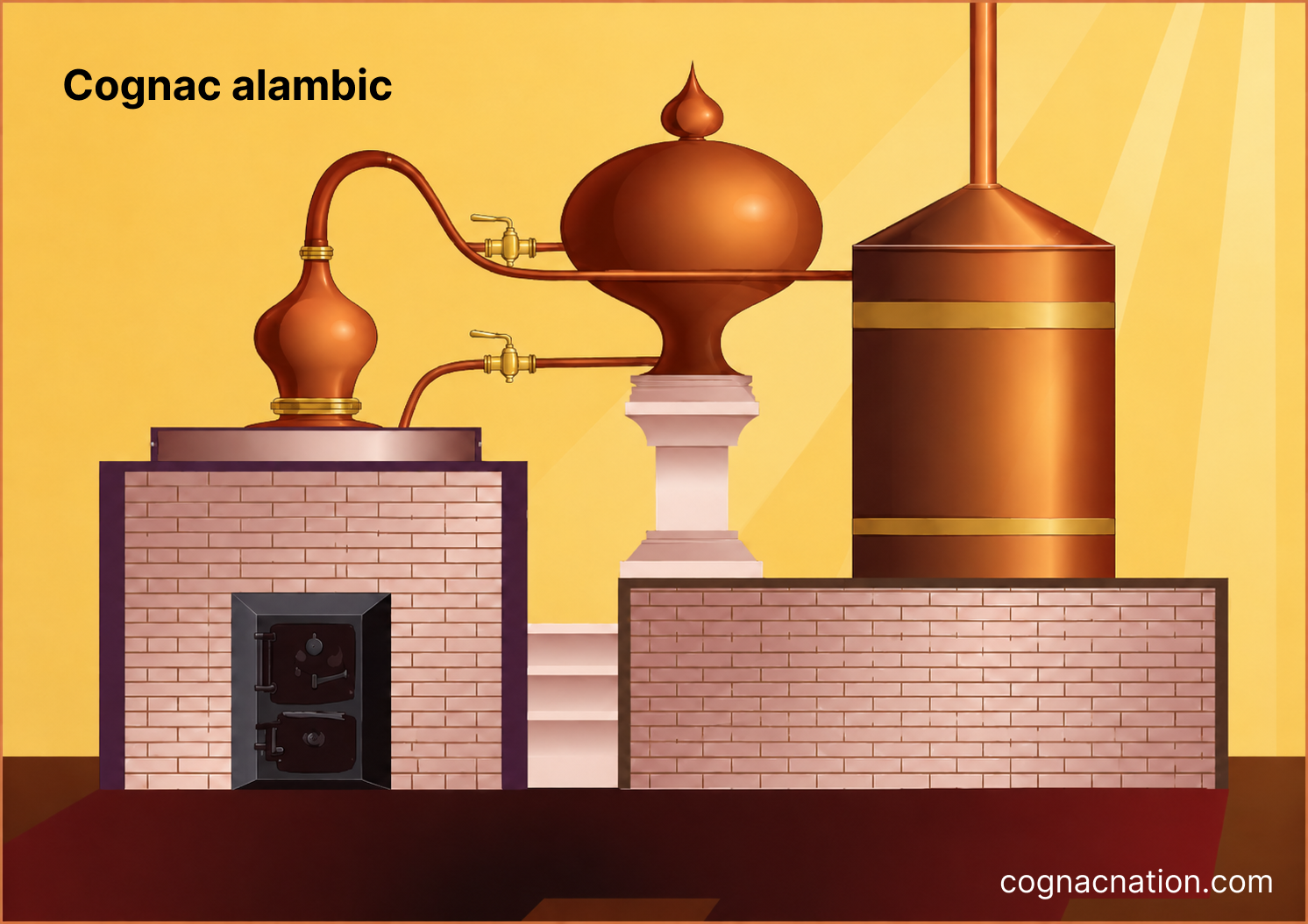
Every cognac is distilled the same way, by law: twice, in a copper pot still called an alambic charentais. The base wine goes through two slow, batch-by-batch passes that concentrate alcohol and flavor while stripping out harsher compounds, producing a clear spirit called eau-de-vie at roughly 70% ABV. There's no variation allowed — it's the same method for every producer in the region.
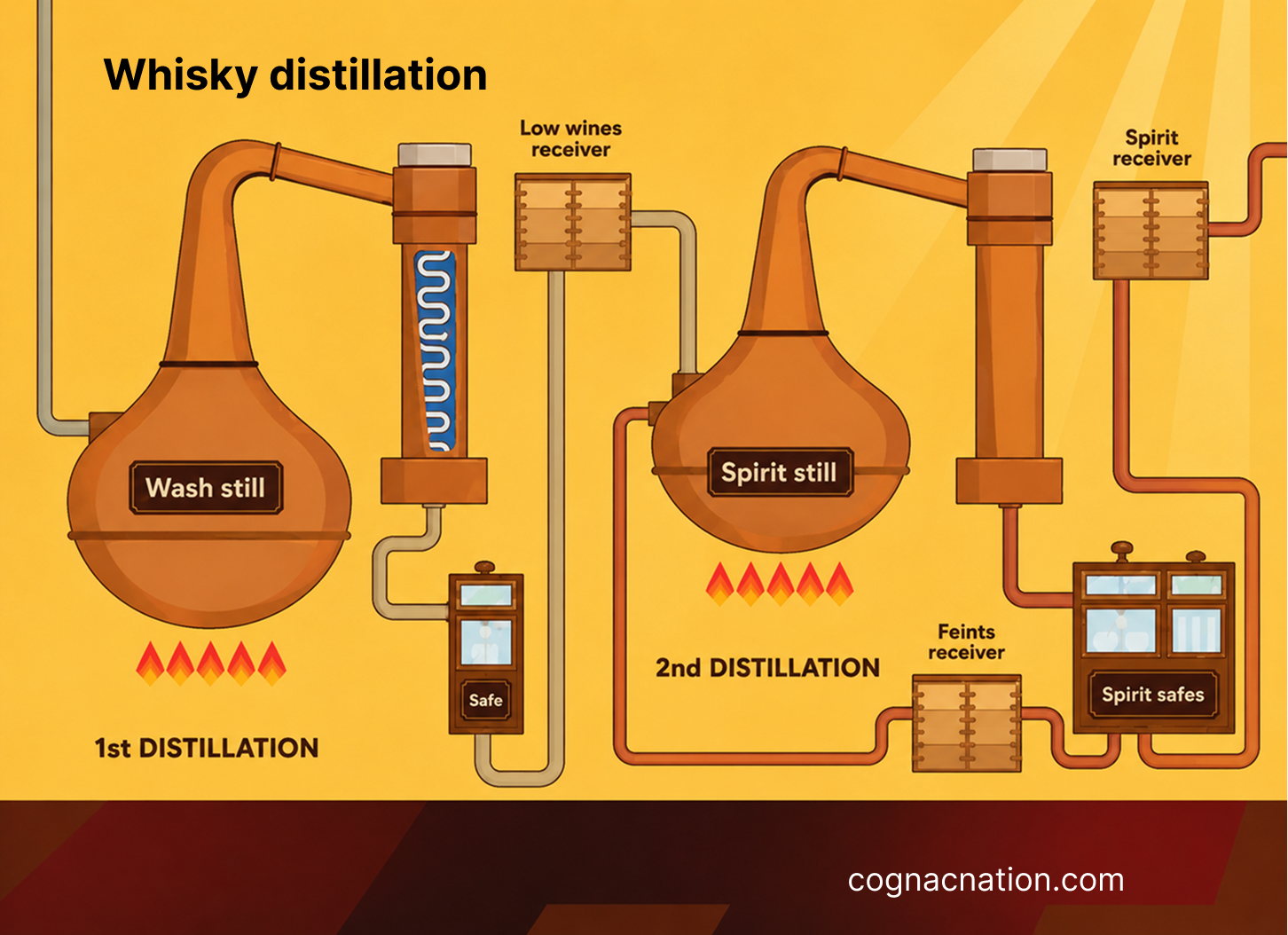
Whiskey has no single method. Scotch single malt is typically double-distilled in copper pot stills, similar in spirit to cognac's process. Irish whiskey is often triple-distilled. Bourbon and most American whiskey run through a continuous column still first, frequently followed by a second pass through a smaller pot still called a "doubler." That variation is itself a difference from cognac: whiskey's flavor depends heavily on which distillation method a given producer chose, while cognac's double-pot-still rule is fixed for everyone.
Aging Rules: Cognac vs. Scotch vs. Bourbon
This is where the two categories diverge most sharply, and where "whiskey" stops being one thing and splits into several.
| Rule | Cognac | Scotch | Bourbon |
|---|---|---|---|
| Minimum aging | 2 years | 3 years | None (2 years for "straight bourbon") |
| Barrel type | French oak (Limousin or Tronçais) | Oak casks, often previously used for bourbon or sherry | New, charred American oak only |
| Where it must age | France | Scotland | United States |
Cognac's two-year floor is set by the Bureau National Interprofessionnel du Cognac (BNIC), the region's regulatory body — though most cognac ages well past the minimum, which is why classifications like VS, VSOP, and XO exist at all. Scotch's three-year minimum in oak casks is set by the Scotch Whisky Regulations 2009. Bourbon is the outlier: under federal standards of identity (27 CFR 5.143), plain "bourbon" has no minimum aging requirement at all — the two-year floor only kicks in once a bottle is labeled "straight bourbon." Bourbon also has to use a brand-new charred barrel every time, while cognac and Scotch both reuse oak across multiple fills.
Flavor Profile: What Actually Tastes Different
Cognac's flavor comes from three sources working together: the grape base, French oak, and long aging. Expect dried fruit (fig, apricot), vanilla, baking spice, and a floral note from the Ugni Blanc grape, with a texture that's usually smoother and lighter-bodied than most whiskey at a comparable age.
Whiskey's flavor range is wider because the category itself is wider. Bourbon leans sweet — caramel, vanilla, and toasted coconut pulled hard from new charred oak and a corn-heavy mash. Scotch swings from light and floral (much of Speyside) to intensely smoky and medicinal (Islay malts finished over peat smoke). Rye whiskey runs drier and spicier, with black pepper and clove standing in for bourbon's sweetness. None of these profiles overlap with cognac's grape-and-oak character, which is why swapping one for the other in a cocktail changes the drink more than people expect.
Where Each One Can Legally Be Made
Cognac can only be made in the delimited Cognac region of France, the same way Champagne can only come from the Champagne region — it's an AOC-protected name, and a grape brandy made anywhere else, even using the identical method, legally cannot be called cognac.
Whiskey doesn't work that way as a category, even though individual styles inside it carry their own geographic rules. "Scotch" must be distilled and matured in Scotland. "Bourbon" must be distilled and aged in the United States. But "whiskey" itself, unlike cognac, isn't tied to a single country — Japan, Ireland, Canada, and dozens of other countries all produce whiskey legally under their own national rules. Cognac has no equivalent looser tier; there's exactly one place it can come from.
Cognac vs Whiskey: Which Should You Drink?
If you already like bourbon's sweetness or Scotch's smoke, cognac will read as lighter and more fruit-forward — worth trying specifically because it won't taste like more of the same. If you're new to both, a VS cognac and a bourbon at a similar price point make a genuinely useful side-by-side; the grape-versus-grain difference is obvious even to a first-time taster. For the full breakdown of what separates VS, VSOP, and XO, see our guide to cognac classifications, and if you're drinking it for the first time, our guide to drinking cognac properly covers glassware, temperature, and neat vs. mixed.
In cocktails, the two aren't interchangeable despite both being "brown spirits." An Old Fashioned or Manhattan is built around whiskey's grain sweetness and won't taste right with cognac subbed in. A Sidecar or French 75 is built around cognac's fruit and floral notes and loses its point with whiskey instead. Match the spirit to the recipe rather than treating them as swappable.
Once you know what you're comparing, the easiest way to pick a bottle is seeing what other people who've actually tasted it think. On Cognac Nation, members rate and review bottles on a 0–100 scale, so you can compare a specific cognac against others in its price range before you commit — browse the full cognac catalog to start.
Frequently Asked Questions
Is cognac a whiskey?
No. Cognac is a grape brandy, distilled from fermented wine. Whiskey is distilled from a fermented grain mash — barley, corn, rye, or wheat depending on the style. They're both aged brown spirits, but they belong to separate legal categories with different production rules.
Is cognac stronger than whiskey?
Not typically. Both are usually bottled around 40% ABV (80 proof), which is the legal minimum for whiskey in the US and for cognac under EU spirit regulations. Strength comes down to the individual bottle's proof, not the category.
What's the difference between cognac and bourbon?
Cognac is made from grapes, double-distilled in copper pot stills, and aged a minimum of two years in French oak. Bourbon is made from a corn-heavy grain mash, typically distilled in a column still, and aged in new charred American oak with no minimum aging requirement for the base "bourbon" label.
Can I substitute whiskey for cognac in a cocktail?
Not without changing the drink. Whiskey's grain sweetness and cognac's grape-and-oak character push a recipe in different directions — a Sidecar made with whiskey or an Old Fashioned made with cognac will taste noticeably different from the original, not just a variation on it.
Is cognac better than whiskey?
Neither is objectively better — they're different spirits built from different rules. Cognac tends to suit people who prefer fruit-forward, lighter-bodied spirits; whiskey (in its many styles) covers everything from bourbon's sweetness to Islay Scotch's smoke. The right one depends on what you're pouring it for.