


Armagnac and cognac are often lumped together as "French brandy," and technically that's correct — both are grape brandies made in protected regions of France, under similarly strict rules. But pour them side by side and the differences are obvious immediately: Armagnac is rougher, more rustic, and more variable bottle to bottle, while cognac is smoother and more consistent. That's not an accident of branding. It comes from two genuinely different sets of production rules.
Here's the difference between cognac and Armagnac that actually matters — the still, the region, the classification system, and what all of that does to what's in the glass.
What Is Armagnac?
So what is Armagnac, exactly? It's a grape brandy made in Gascony, in southwest France, under an AOC (Appellation d'Origine Contrôlée) regulated by the Bureau National Interprofessionnel de l'Armagnac (BNIA) — the same kind of protected-name system that governs cognac, just for a different region and a different set of production rules. It's widely considered the older of the two French brandies, with production in Gascony predating cognac's rise as the dominant export style.
Armagnac vs Cognac: The Core Differences
In a straight cognac vs Armagnac comparison, six factors do most of the explaining:
| Armagnac | Cognac | |
|---|---|---|
| Region | Gascony, southwest France | Cognac, western France |
| Regulator | BNIA | BNIC |
| Distillation | Single pass, continuous column still | Double pass, copper pot still |
| Off-still strength | 52–60% ABV | ~70% ABV |
| VS minimum age | 1 year | 2 years |
| Typical style | Rustic, earthy, more variable between houses | Polished, consistent, house-blended |
The single biggest difference isn't the region — it's the still. Everything else about how the two spirits taste traces back to that one production choice.
How Armagnac Is Actually Made
Armagnac is distilled just once, in a continuous column still known as the alambic armagnacais — a design that's technically still distilling as long as base wine keeps feeding into it, unlike cognac's batch-by-batch copper pot still. The alcohol vapor rising through the column's plates bubbles back through fresh wine on its way up, pulling in more of the wine's own aroma and flavor before it ever reaches a barrel.
That single pass comes off the still at a relatively low 52–60% ABV, compared to roughly 70% for cognac's double-distilled eau-de-vie. A lower-proof, single-pass spirit carries more of the original wine's character through into the final product — rougher, more textured, more obviously agricultural. Cognac's double distillation strips more of that away in exchange for polish and consistency.
Inside the Still: Pot vs Column
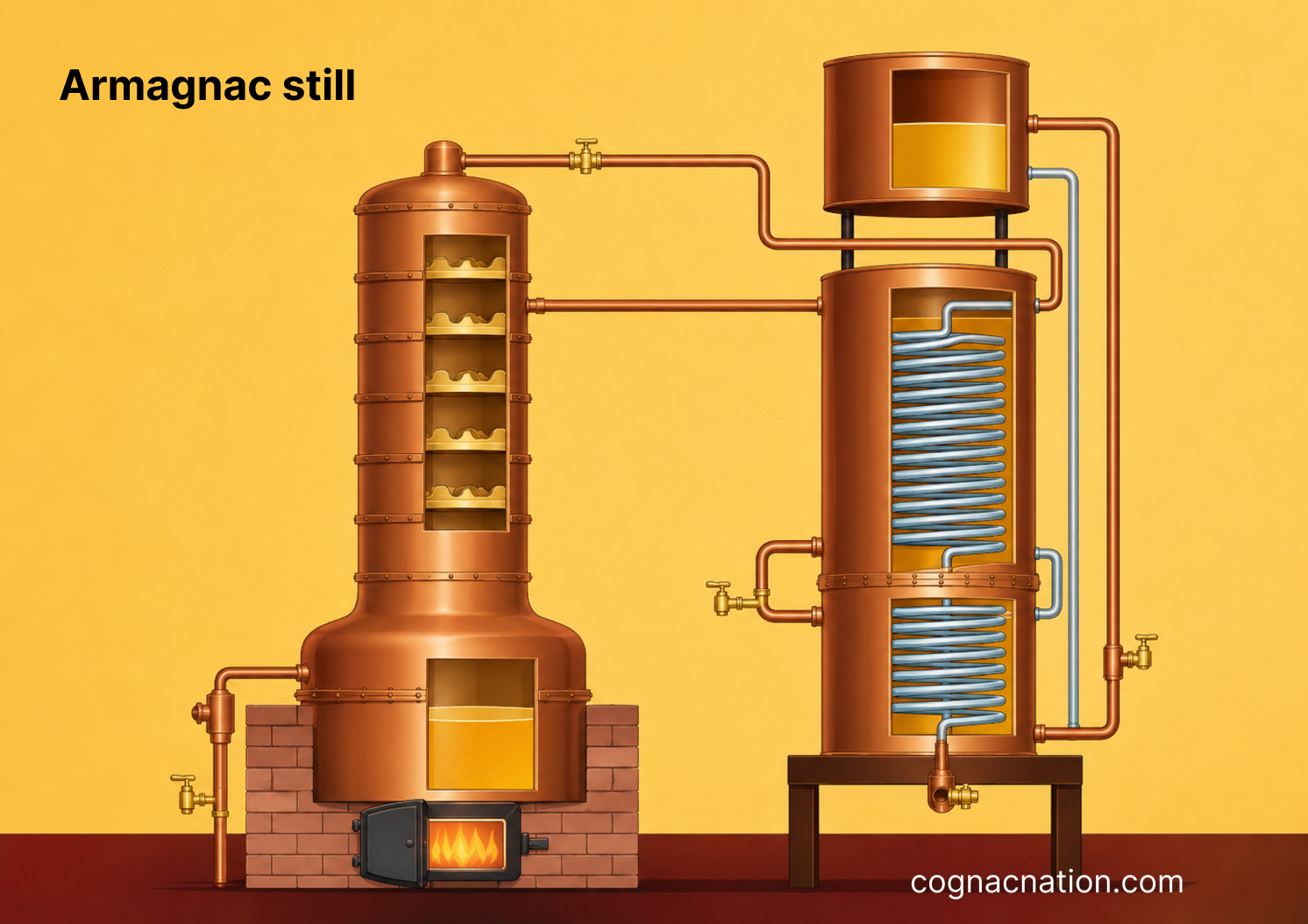
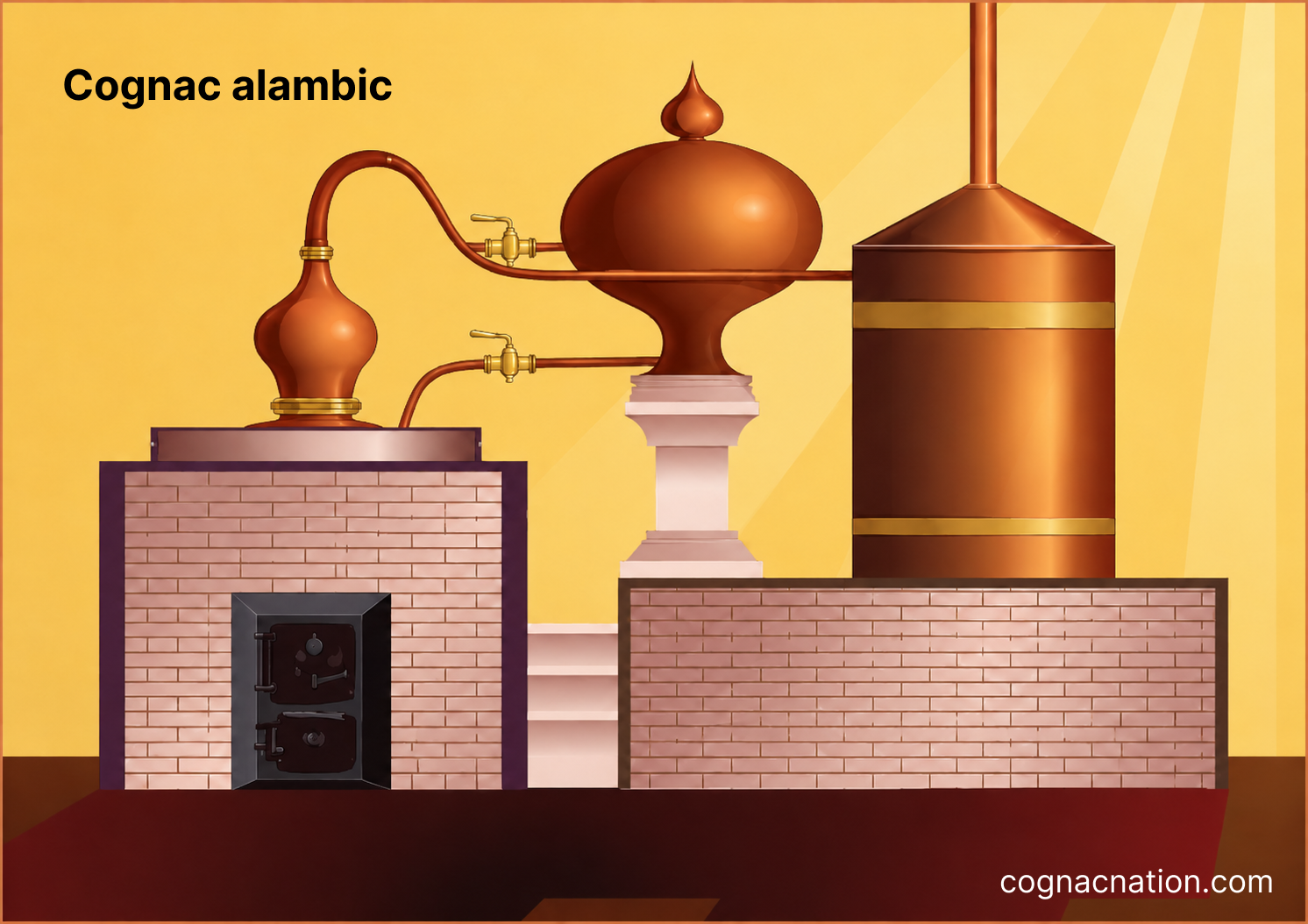
Armagnac — Alambic Armagnacais
Continuous column still, single pass
1. Feed the column
Base wine is fed continuously near the top of the alambic armagnacais.
2. Wine falls, vapor rises
Wine trickles down through perforated plates while heated vapor climbs up through them.
3. Vapor bathes in wine
At each plate, rising vapor bubbles through fresh wine, pulling in more of its aroma — one pass only.
4. Draw off continuously
Spirit is drawn off the column as long as wine keeps feeding in. Result: ~52–60% ABV eau-de-vie.
Cognac — Alambic Charentais
Copper pot still, double pass
1. Charge the pot
Base wine (~9% ABV) goes into the copper boiler of the alambic charentais.
2. First pass — "brouillis"
Heated once; vapor rises through the swan neck, cools in a coiled condenser. Comes off cloudy, ~28–32% ABV.
3. Second pass — "bonne chauffe"
The brouillis is redistilled in the same pot still — the defining double-distillation step.
4. Cut the heart
Only the "coeur" (heart) is kept; heads and tails are discarded. Result: ~70% ABV eau-de-vie.
From Grapes to Bottle
The still is just one step, though — zoom back out and here's the entire path from grape to bottle for both spirits, side by side.
Armagnac
1. Grapes & Wine
Ugni Blanc, Baco, Colombard, or Folle Blanche, grown in Gascony.
2. Distill
Single pass through a continuous column still ("alambic armagnacais").
3. Off the still
52–60% ABV — lower proof, more of the base wine carries through.
4. Age
Minimum 1 year in oak for VS; most premium bottles age far longer.
Cognac
1. Grapes & Wine
Ugni Blanc, grown only inside the delimited Cognac region.
2. Distill
Double pass through copper pot stills ("alambic charentais").
3. Off the still
~70% ABV — higher proof, a cleaner and more refined spirit.
4. Age
Minimum 2 years in French oak for VS.
The Three Terroirs of Armagnac
Cognac is famous for its crus — Grande Champagne, Petite Champagne, and the rest. Armagnac has its own, smaller version of the same idea: three terroirs, each producing a noticeably different style.
Gascony — Armagnac AOC (west → east)
Bas-Armagnac
West · sandy-clay soil · ~3,480 ha planted
Lightest, most fruit-forward — prune, vanilla
Ténarèze
Center · clay-limestone soil · ~1,588 ha planted
Structured — cocoa, leather, spice
Haut-Armagnac
South & east · clay-limestone soil · ~68 ha planted
Light, floral — rare
Arranged roughly west to east; box width reflects share of planted area, not exact geographic scale.
- Bas-Armagnac — light, sandy-clay soil, producing the lightest and most fruit-forward style, often with notes of prune and vanilla. Most premium single-estate bottlings come from here.
- Ténarèze — clay-limestone soil, producing a more structured, powerful spirit that develops cocoa, leather, and spice notes with extended aging.
- Haut-Armagnac — the smallest and least-planted zone, clay-limestone soil producing a lighter, floral style; bottlings from here are comparatively rare.
Most Armagnac on shelves is a blend across these zones, but single-terroir bottlings — especially from Bas-Armagnac — are common enough to actively look for if the rustic, fruit-driven style is what you're after.
Armagnac's Own Age Classifications
Armagnac runs a classification system that looks familiar if you know cognac's VS/VSOP/XO ladder, but the minimums don't line up exactly:
| Classification | Minimum aging |
|---|---|
| VS | 1 year |
| VSOP | 4 years |
| Napoleon | 6 years |
| XO / Hors d'Age | 10 years (often considerably older) |
The gap that stands out: Armagnac's VS only needs a single year in oak, half of cognac's two-year minimum — read our full breakdown of cognac's VS, VSOP, and XO tiers for the comparison. Armagnac also has a category cognac doesn't use in the same way: Millésime, a vintage bottling from a single named harvest year, unblended — a style Armagnac producers lean on more heavily than cognac houses do.
Taste Differences
Side by side at a similar age, Armagnac reads earthier and more rustic — prune, dried fig, leather, baking spice, sometimes an almost savory edge. Cognac at the same age tends toward cleaner fruit, vanilla, and oak, with less of the raw, agricultural character that single distillation leaves behind.
Neither is more "correct." Armagnac drinkers often describe cognac as polished to the point of sameness across houses; cognac drinkers often find young Armagnac too rough to sip neat. Both reactions are really just a description of what double versus single distillation actually does to a spirit.
Which Should You Choose?
If you want consistency — a bottle that tastes close to what you expect before you open it, house to house — cognac's double distillation and larger-scale blending deliver that reliably. If you want more character, more texture, and more variation bottle to bottle, and don't mind some rough edges in exchange for it, Armagnac is where to look. Bas-Armagnac specifically is the easiest on-ramp for a cognac drinker curious about Armagnac, since it's the lightest and most fruit-forward of the three terroirs.
Once you know what you're looking for, the fastest way to check whether a specific bottle delivers on it is seeing what people who've actually tasted it think. On Cognac Nation, members rate and review bottles on a 0–100 scale, so you can compare a cognac against others in its class before you commit. Browse the full cognac catalog by classification, or read our guide to what separates cognac from brandy generally if Armagnac has you rethinking the category altogether.
Frequently Asked Questions
Is Armagnac better than cognac?
Neither is objectively better — they're built on different production choices for different results. Cognac's double distillation produces a more polished, consistent spirit; Armagnac's single distillation produces something rougher and more characterful. Which is "better" depends entirely on what you want from the glass.
Is Armagnac stronger than cognac?
Not in the bottle — both are typically sold around 40% ABV. Off the still, Armagnac is actually lower proof (52–60%) than cognac's roughly 70%, since it's distilled only once.
Why is Armagnac cheaper than cognac?
Smaller production scale, less international marketing spend, and a single distillation pass that's faster and less labor-intensive than cognac's double distillation all keep Armagnac's average price below cognac's, even at comparable ages.
What is the difference between Armagnac VS and cognac VS?
Armagnac VS requires just 1 year of aging; cognac VS requires a minimum of 2. It's the clearest single number that shows how the two classification systems diverge even when the letters match.
What does Millésime mean on an Armagnac label?
Millésime marks a vintage Armagnac — the entire bottle comes from a single named harvest year, unblended with any other year. It's a style Armagnac uses more prominently than cognac, which almost always blends across multiple years even within one age classification.